


08 Apr Global Mobility in 2026: Why the Bay Area Remains the Nerve Center of a Distributed Workforce
The global workforce has never been more dispersed. U.S. companies are hiring across borders, building teams that stretch from Latin America to Southeast Asia, and operating around the clock. But for global mobility leaders, the more important question is not where work is spreading—it’s where it still needs to come together.
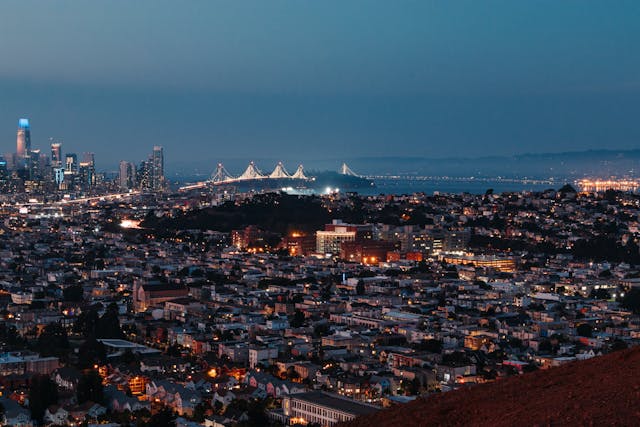
And in that equation, the San Francisco Bay Area remains firmly at the center.
There is no denying the shift. Data from Remote shows that U.S. companies are increasingly employing talent across multiple countries while maintaining strong domestic teams.
This reflects a structural change in how work is organized:
- execution can now happen anywhere
- teams are built across time zones
- capacity is no longer tied to a single geography
But this model introduces a new challenge. As organizations distribute work, they also increase the complexity of managing it. Coordination, alignment, and decision-making become harder, not easier. And that is where geography still matters.
More specialized with control layer
The bay area’s role is evolving—not diminishing. Rather than becoming obsolete, the Bay Area is becoming more specialized.
Recent analysis from CBRE continues to rank the San Francisco–San Jose region among the world’s leading tech talent markets, citing its concentration of highly skilled workers and deep innovation ecosystem.
At the same time, workforce data from PwC shows that companies are maintaining core hubs for leadership, strategy, and innovation—even as they expand globally distributed teams.
Together, these signals point to a clear shift: the Bay Area is no longer where all work happens. It is where the most important work happens.
In the past, regions like the Bay Area housed entire organizational stacks: from support functions to advanced engineering. Today, much of the scalable work has been distributed globally.
What remains is the control layer:
- product strategy
- AI and advanced engineering leadership
- venture capital and startup formation
- executive decision-making
This concentration is not accidental. It reflects the realities of how high-value work is done.
When decisions are complex, stakes are high, and speed matters, proximity still provides an advantage.
Why companies still anchor in the Bay Area
Even in a distributed environment, companies continue to rely on hubs like the Bay Area for three reasons:
- Speed of decision-making
Leadership teams can align faster when they are physically proximate, especially in high-pressure environments like product launches or funding cycles.
- Ecosystem density
The Bay Area offers a unique concentration of:
- venture capital
- technical talent
- startup infrastructure
These networks create opportunities that are difficult to replicate elsewhere.
- Innovation feedback loops
Product, engineering, and leadership teams can iterate more quickly when they operate within the same environment.
These factors explain why, even as hiring spreads globally, the Bay Area continues to anchor the most critical functions.
Mobility is becoming more strategic
For global mobility leaders, this shift has direct implications.
If talent is increasingly hired in place—rather than relocated—then traditional long-term assignments become less common. But mobility does not disappear.
Instead, it becomes more targeted.
Employees based in other regions may still travel to the Bay Area for:
- onboarding and team integration
- leadership alignment
- key project phases
This creates a pattern of episodic mobility:
- shorter stays
- higher frequency
- greater strategic importance
In this model, movement is no longer constant—but when it happens, it is essential.
What this means for workforce strategy
The emerging structure of work can be understood as a layered system:
- global talent hubs provide scale and execution
- central hubs like the Bay Area provide direction and control
For companies, the challenge is integrating these layers effectively.
For global mobility leaders, the role expands from managing relocation to designing systems that:
- connect distributed teams
- enable strategic movement
- support moments that require physical presence
As work becomes more distributed, the need for coordination increases. Companies must align teams across time zones, manage complex workflows, and maintain a unified strategic direction.
The Bay Area continues to serve as one of the primary anchors for this system. It is where:
- leadership teams converge
- critical decisions are made
- innovation is shaped
Rather than being replaced by global hiring, it is reinforced by it. The rise of distributed work has changed where tasks are performed—but not where value is created. Execution may be global but control remains concentrated.
For global mobility and talent leaders, the implication is clear: The Bay Area is not becoming less relevant. It is becoming more focused—and more essential to how modern organizations operate. In a world where talent can be anywhere, the places where it must occasionally come together matter more than ever. And the Bay Area remains one of those places.